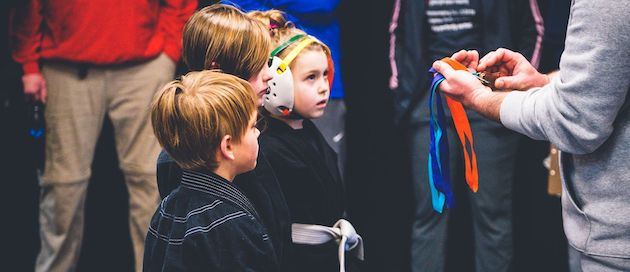
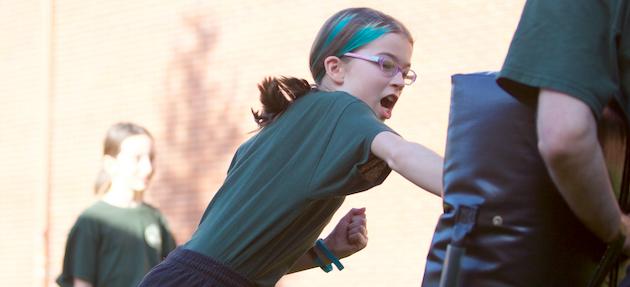
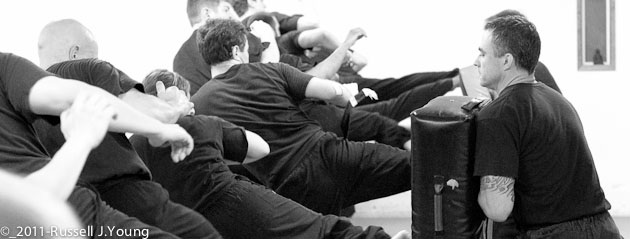
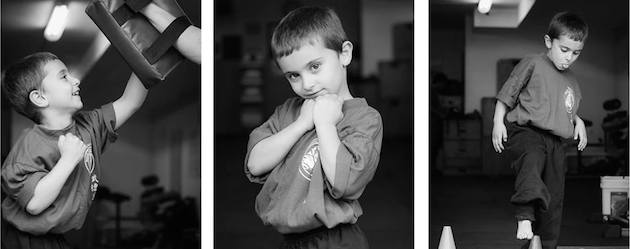
Thursdays is our sparring class for kids. What’s that mean? It means we put on the gloves and the shin guards and we play. We don’t go hard – and that’s not just because it’s kids class. We don’t go hard in adult class either. We keep our sparring light.
What’s “light” mean? Light to us means touching the head. Light to the body means a hit that can be felt but doesn’t push the body out of alignment. Light to the legs means the same kind of thing – you feel it but it doesn’t hurt.
We believe that in order to learn functional martial arts, there needs to be contact. We also believe that hard contact, especially to the head, and especially in children, is counter productive.
It’s definitely true that the body and legs can adapt to contact – meaning if you train over time, you can get used to harder contact – but that’s only something we do in adult classes and even there we take our time, never cross anyone’s limits, and never go hard to the head.
Interested in our kids martial arts classes? Check out the schedule here.
SW Portland Martial Arts Blog
Sparring in Kids Class
September 6th, 2025Defense
September 2nd, 2025
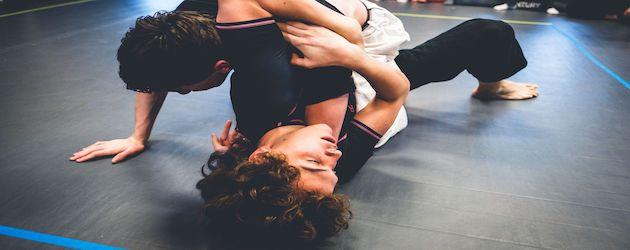
For September, the theme in our BJJ classes is “late stage defense.” What’s that mean? It means how do we get out of bad positions and submissions. It also means learning to recognize the level of threat you’re under. If you can’t identify how bad the situation you’re currently in is, it can be very tough to defend. Finally, it will mean learning how to not simply escape submission threats, but how to immediately move into a counter attack.
Practically, that will mean drilling and naming bad positions. This will require both solid offense and solid defense. In order to know how to escape an armbar, you need a partner with a decent armbar. If you’ve got a partner with a lousy armbar, you’re not going to improve your defense training with them.
If you’re interested in training BJJ with us, come try a free week. Our schedule is here. If you’ve never done any martial arts, no sweat. We love welcoming beginners into the art. Come in and we’ll work with you at your speed.
Throwing Medicine Balls
August 29th, 2025
Some gyms, so I’m told, are barbell-centric. Others are HIIT centric. So which are we? We’re community centric.
Too cheesy of an answer? Too much of a dodge? Alright, fine. We use the barbells, we spend time dissecting how to properly lift. We also do HIIT and spend time practicing good technique for bodyweight movements.
Still a weak answer? I guess I’m not up to picking a side, because I find the debate to be meaningless. We’re here to learn how to move properly, with barbells and without. Today we threw medicine balls. Tomorrow we might throw barbells. Either way, we’re going to use good technique and develop quality movement patterns that are going to make us more awesome humans both inside and outside of the gym.
Interested in CrossFit? Come try a free week. It’s our standard offer for all new students. Click here for the schedule and signup for any class at no charge.
Muscle versus Power
August 27th, 2025
We’ve been spending this week looking at the difference between a “muscle” motion and a “power” motion. The clean, snatch, and other related lifts can be dissected this way.
Today we worked the dumbbell snatch. So if you do the “muscle” version, it means you simply throw the dumbbell using your legs as the primary driver and the arm whips the weight up. If you do the “power” version, it means you did everything you did in the “muscle” version, but you don’t have to throw it quite as high because you also land underneath it (not in a squat, but anything shy of that.)
So why choose either of these two versions? Well, the “muscle” version is faster, so if you’re doing a CrossFit workout with 9 reps of a dumbbell snatch and you can do the motion without having to get under the weight, it makes sense to use the “muscle” version. If, however, the weight is too heavy and you find yourself starting to press the weight instead of throwing it, it makes more sense to do the “power” version.
Developmentally, it’s important to learn both motions, because they are both useful and they build on one another. Ideally, you’d learn the “muscle” version first, and then the “power” motion, but different folks have varying ease picking up one movement over the other.
Interested in CrossFit? Check out our schedule and try a free week.
Mostly don’t Cross Your Feet
August 26th, 2025
If you’ve done any striking arts, you’ve undoubtedly heard a coach say, “don’t cross your feet.” Most of the time, in most circumstances during sparring, this is the correct thing to do. If you want to move forward in your stance, you generally move the front foot first and then the back foot. Similarly, if you want to move backwards, you usually move the back foot first and then the front foot. The primary idea at work here is you want to maintain balance and the ability to move in any direction should the situation demand it.
That’s the basic, and as already stated, it’s how you should move most of the time.
If, however, your partner is trying to tackle you, it probably won’t be enough to step back in the “correct” way. Instead, one strategy is to switch stances – to step your front foot all the way back (cross your feet) and then bring your (new) front foot back so your in a good stance again. This will make it harder for your partner to reach you (you’re further away.) If you feel like reminding them not to try and take you down, you can add in an uppercut as you step back. Your hand that was in the back (and will become your lead) will swing up right as you complete your footwork. If you time it right, you’ll hit them right in the chin and they probably won’t try a take down again.
We worked this today in our Mo Duk Pai class – where we generally do striking but we also make sure we know basic defense against folks who would like to take us to the ground. Join us Tuesdays and Thursdays at Noon and/or Mondays and Wednesdays at 7pm.